
How does breastfeeding work?
For you, the mechanisms behind breastfeeding are probably quite mysterious.
Why is breastfeeding on demand rather than according to a predetermined schedule? What is a growth spurt? Why is it so important for Mum to be relaxed for breastfeeding to go smoothly?
In this section, we'll reveal the essentials you need to know to navigate this special period with confidence.
Feeding on demand
If you're naturally curious, you may have delved into specialist books to find out what to expect after your baby is born. You may have read that during the first few weeks of life, a newborn feeds on average every 3 hours. But this ideal schedule doesn't apply to breastfed babies: their feeding pattern depends above all on Mum's breast storage capacity, which in turn affects the amount of milk produced over 24 hours.
Storage capacity
The amount of milk stored in the breast varies from one woman to another and is not related to the external size of the breast.
In other words, a larger breast may well have a lower storage capacity than a smaller breast.
Differences in storage capacity explain why your baby needs to breastfeed on demand rather than according to a set schedule: your little one may only be able to access a small amount of milk at a time and therefore needs to feed more frequently to get the amount they need throughout the day.
Milk supply adapts to demand
Another fundamental principle of breastfeeding: the amount of milk produced by the mother depends entirely on the baby's demand. In other words: the more your baby breastfeeds, the more milk Mum produces.
This wonderful mechanism allows your baby to always get the amount of milk they need, but it also has a downside: if, for one reason or another, feeds become less frequent for a while (if your baby is ill and refuses to feed, for example), the amount of milk available will inevitably decrease. It is therefore essential to keep stimulating the breasts if this kind of situation arises, in order to prevent unintended weaning.
Growth spurts
What is a growth spurt?
Your baby's milk needs vary over a 24-hour period. When those needs increase, they will simply breastfeed more often.
Their feeding pattern can suddenly become frantic: they want to breastfeed as soon as you take them off the breast and never seem satisfied! That's a growth spurt.
Don't panic: these phases, which can be exhausting for Mum, only last as long as it takes for milk production to adjust, usually between 24 and 72 hours. As soon as the amount of milk available matches their needs, your baby will return to their usual rhythm!
Growth spurt calendar
Your baby is grumpy and crying a lot. But how can you be sure it's a growth spurt? It's simple: just check the calendar!
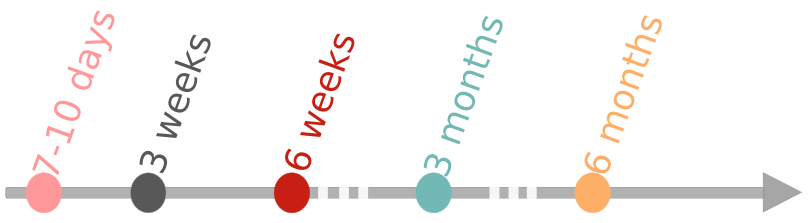
Growth spurts tend to follow a similar pattern in all babies. But keep in mind that these are not fixed, definitive dates, but rather guidelines. Your baby will probably have their growth spurt a few days before or after the expected date.
Check out our dedicated article to learn everything about growth spurts and how to manage them.
Stress and breastfeeding
Postpartum pain, a crying baby, the difficulty of understanding and responding to your baby's needs, constant visits from family, sore breasts, and of course lack of sleep: the first few months with your little one are filled with all kinds of potential sources of stress for your partner. The problem is that stress can interfere with breastfeeding. So you'll need to make sure she is as relaxed as possible to help things go smoothly.
How breastfeeding works
To feed your baby, the mother's body sets off a number of chemical reactions, including the production of two hormones that are essential to breastfeeding: prolactin and oxytocin.
Put simply, prolactin is responsible for milk production, while oxytocin triggers milk ejection: it opens the tap when your baby breastfeeds.
It is this second hormone that can be significantly affected by stress: by slowing down or, in extreme cases, completely inhibiting the release of oxytocin, stress can make breastfeeding very difficult.
It is therefore essential to help your partner stay relaxed.
To help Mum stay relaxed, introduce her to our 100% free sophrology exercise: relaxation guaranteed!
Keeping Mum relaxed
Not sure how to help your partner relax? Here are a few ideas:
Looking after a newborn while also taking care of the household is a huge job, especially when sleep is in short supply. It's hard to let the housework go when visitors keep coming!
Perhaps you could take some of the household chores off her hands, or even get some outside help if that's an option for you?
When you're at home, take over baby duty for a while: bath time, a short walk after a feed... Give your partner some time for herself. And at the same time, give yourself some time with your little one: even if interactions may seem limited at first, your baby learns very quickly and your relationship as father and son (or father and daughter) starts developing from the very first weeks!
Glamformum - Breastfeeding Guide for Dads